
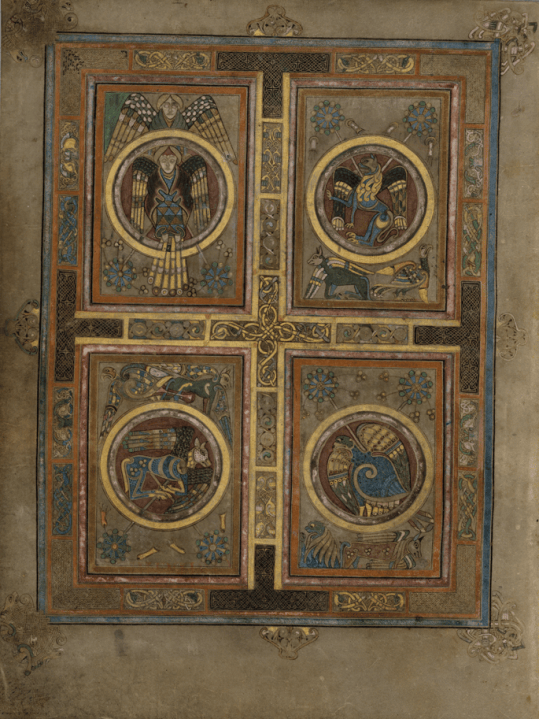
Folios 129v – 130r, Gospel of Mark
Caoimhe Ní Ghormáin
1 min read • 8 October 2026
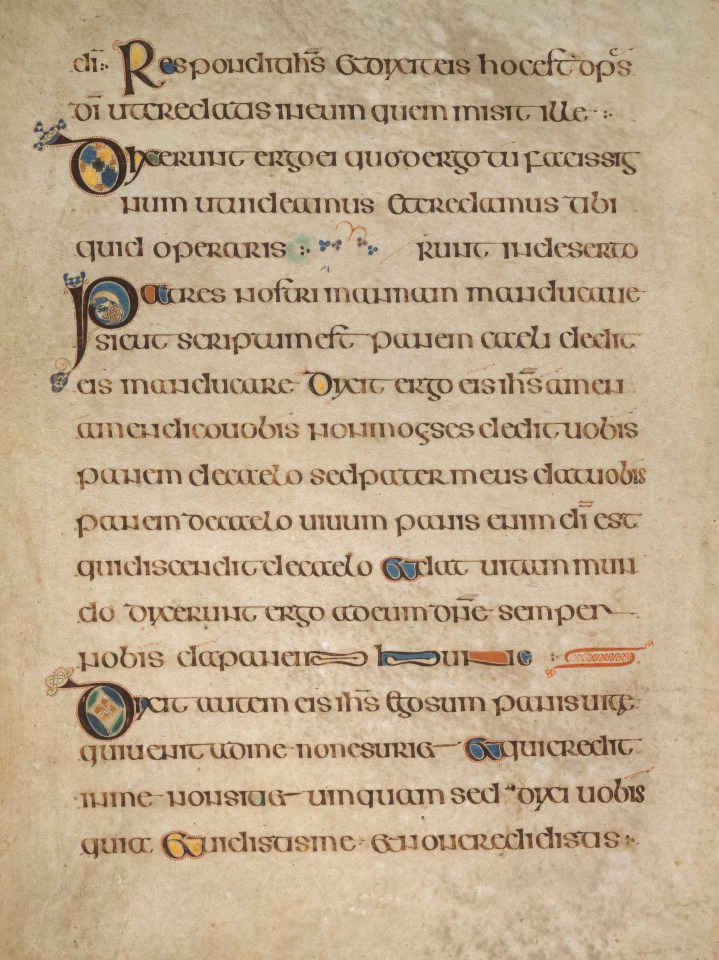
Folio 308v, Book of Kells
The Gospel of John (6.28-42), on display at folios 308v-309r, discusses Jesus’ discourse on the bread of life. Jesus declares that whoever believes in him, eats his flesh and drinks his blood – a reference to his sacrifice and the Eucharist – will have eternal life.
The Book of Kells draws on a diverse decorative inheritance of abstract patterns and animal representations, most of which had long been in use in other media. To account for the formation of the Insular art style, it must be supposed that portable objects such as jewelry, coins, textiles, icons and manuscripts had circulated in Ireland as imports, from the late Classical as well as the Early Christian world.
The three decorated initials at lines 3, 6 and 15 of folio 308v serve to highlight this theory. The initial letter D of Dixerunt ‘they said’ on line 3 is infilled with coloured tiles which have a distinct Mediterranean style.
An animal head set in a vibrant blue background is used to infill the initial letter P of Patres ‘fathers’ at line 6.
A lozenge is used to decorate the initial letter D on line 15 for Dixit autem eis Iesus ‘But Jesus said to them’. The lozenge represented Christ, the logos or Word of God, from early Christian times.
Dots arranged in threes are seen on line 5 of folio 308v and are a common decorative feature in the manuscript. They reflect adoration of the Trinity (Father, Son and Holy Spirit), honoured by the Colomban community, as elsewhere in the medieval world.
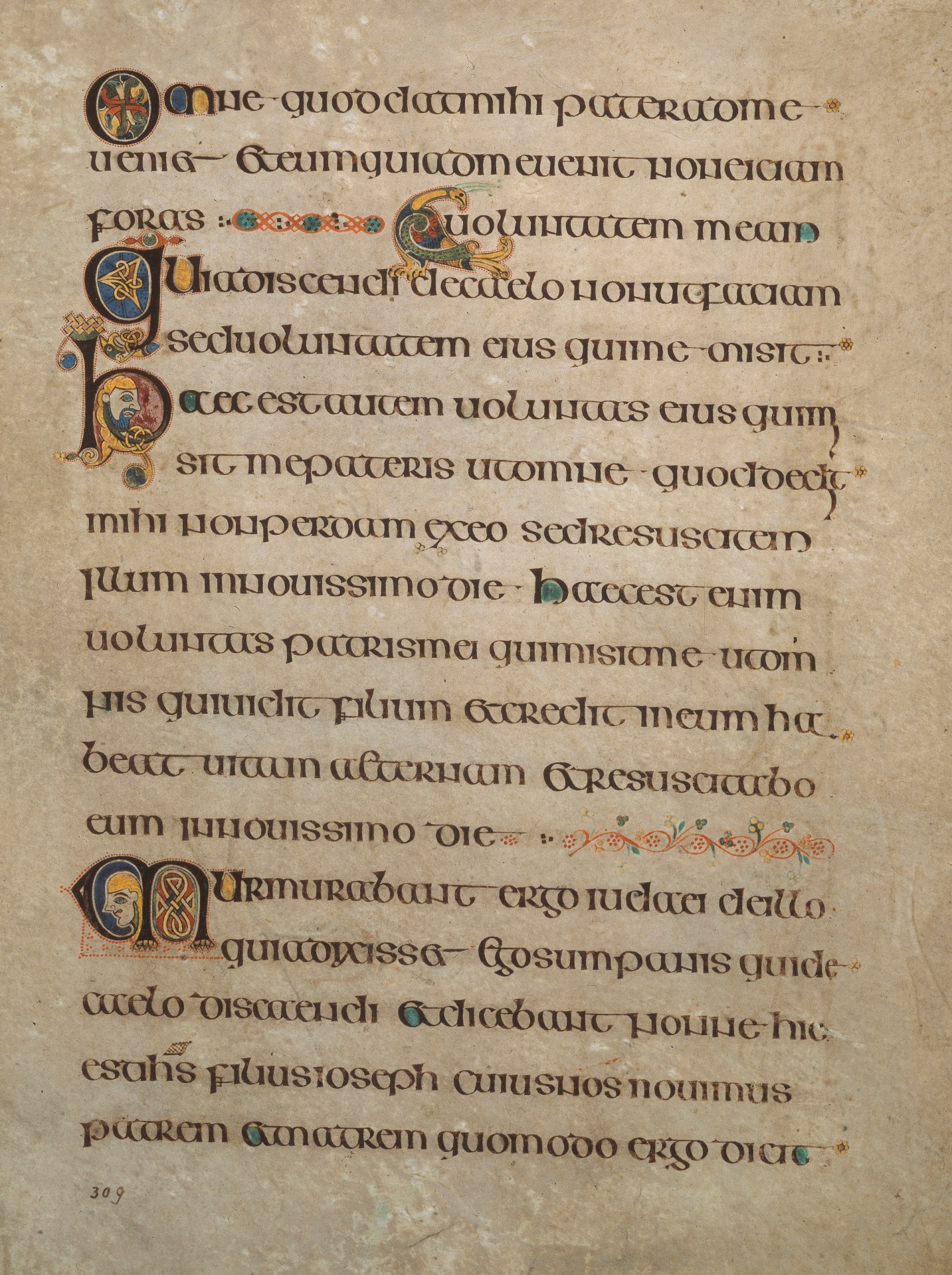
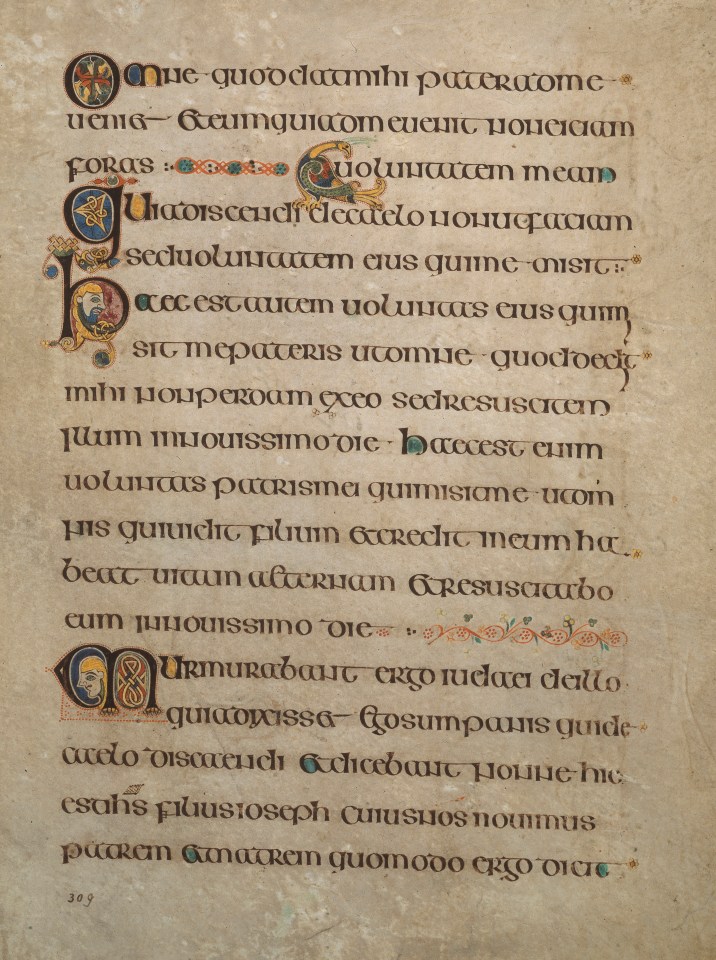
Folio 309r, Book of Kells
The splendid peacock standing on line 4 on folio 309r turns his head towards the two isolated words voluntatem meam (‘my will’) on line 3 which supply the continuation of the text on line 4. Peacocks are integral to the decoration on most of the major pages in the Book of Kells. They appear at line endings, on Canon tables and in key positions next to images of Christ. They are thought to represent Christ’s incorruptibility or immortality, due to the ancient belief that peacock flesh does not decay.
Certain figures are depicted directly in the Book of Kells. Jesus himself is shown most frequently: his profile head appears often, especially when he reveals his identity as God. The two profile heads on this folio may represent God the Father (upper initial H) and below him, Jesus Christ (initial M).
God the Father, with a dark beard, is illustrated inside the first letter of line 6, at John 6:39: Haec est autem uoluntas eius qui misit me pateris ‘Now this is the will of the Father who sent me’, acting as a visual introduction to the text that follows.
The blond head of Jesus appears inside the initial M on line 14 of Murmurabant ergo Iudaei de illo…. hic est Iesus filius Ioseph ‘the Jews murmured at him… is this not Jesus, the son of Joseph’.
One of the most notable features of the Book of Kells is the use of red dots as a scribal technique to highlight important words and passages. These dots serve as a guide for the scribe, ensuring the text is legible and the decorative elements are properly placed. They can be seen here outlining the initial letters at lines 1, 4, 6, and 14, as well as the peacock on line 4.
1 min read • 8 October 2026

1 min read • 26 August 2026
1 min read • 12 May 2026