
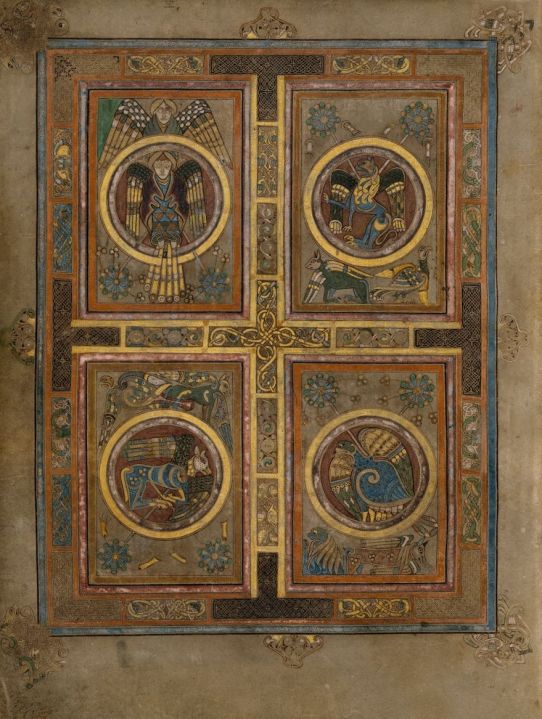
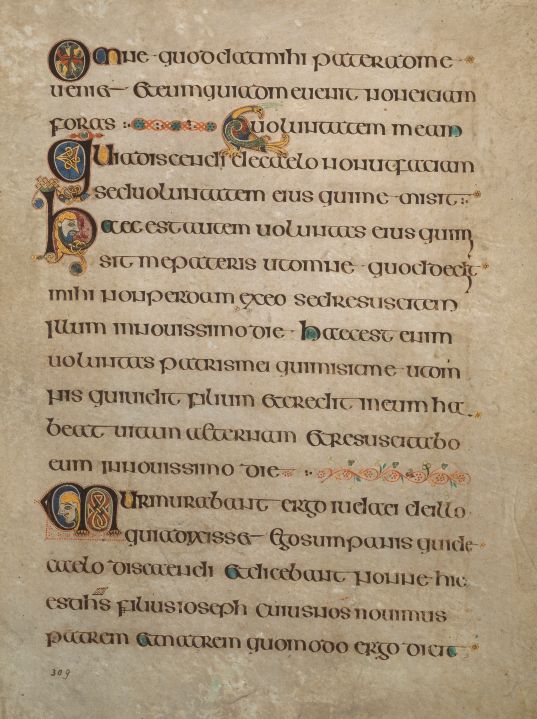
Folios 129v – 130r, Gospel of Mark
Caoimhe Ní Ghormáin
1 min read • 8 October 2026
Book of Kells, folio 188r
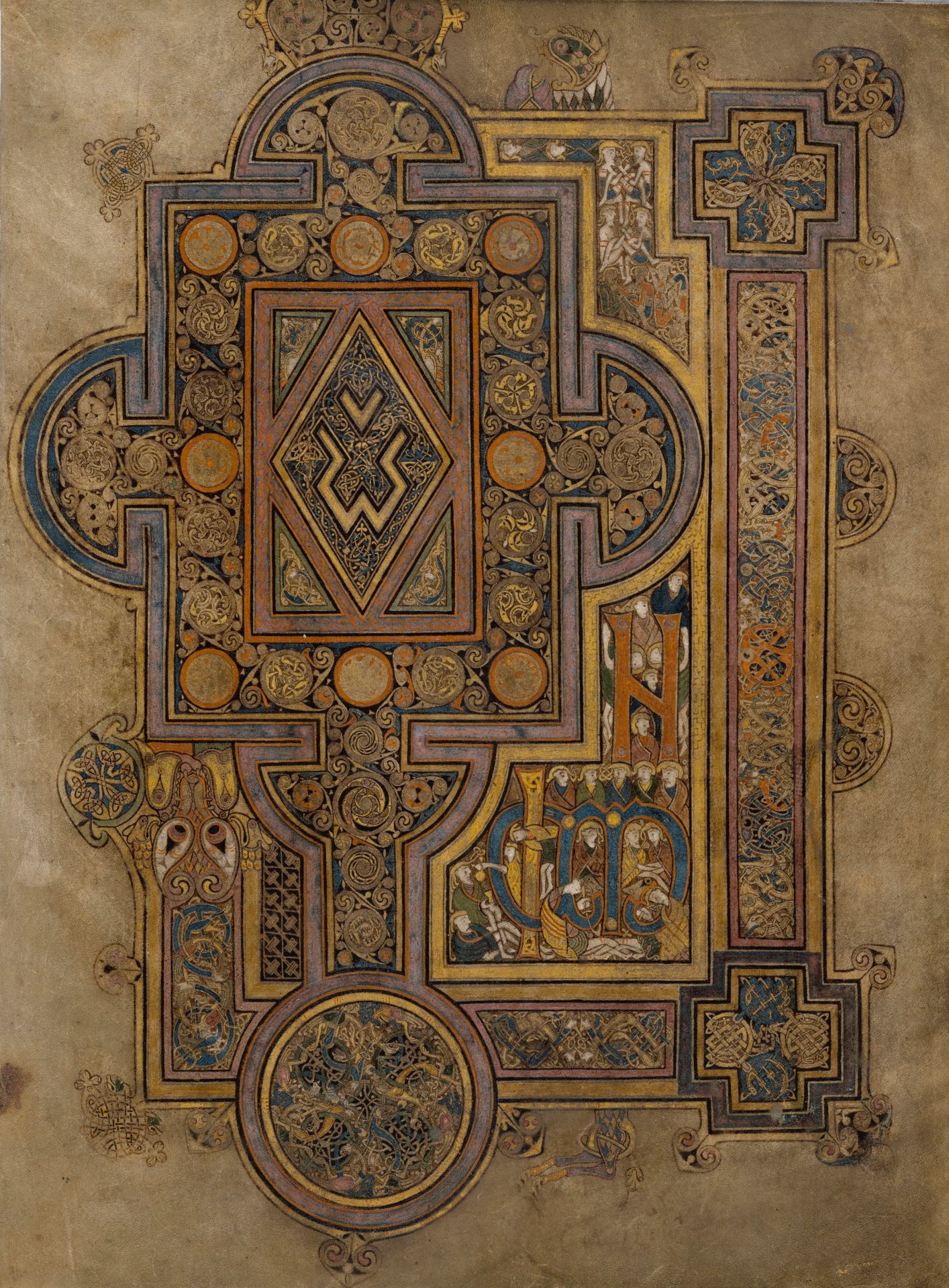
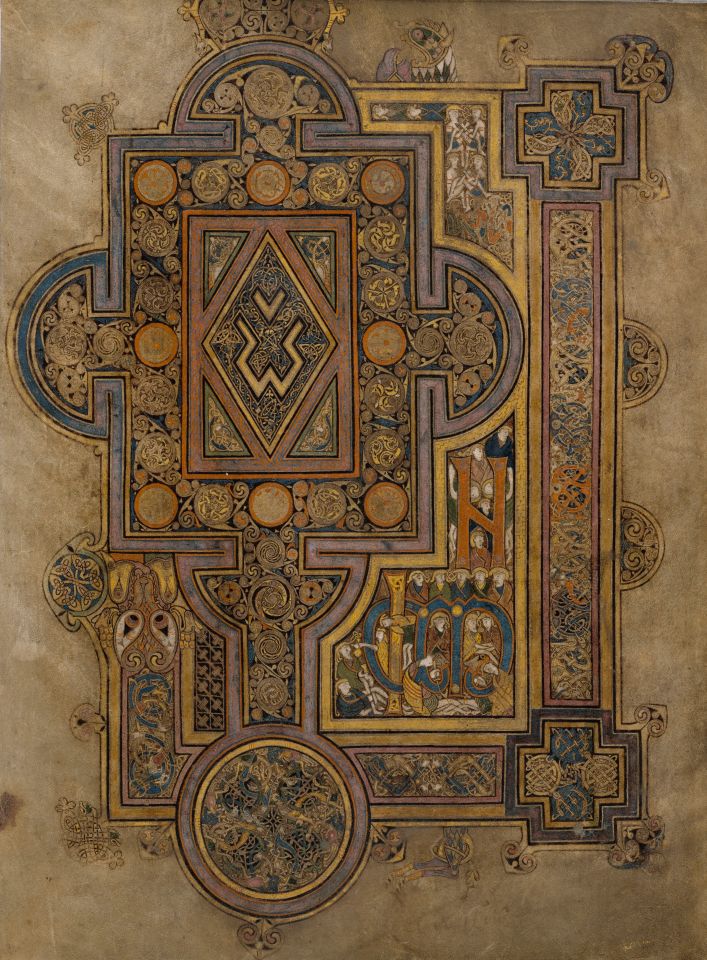
Folio 188r contains the opening word of the Gospel of St Luke, Quoniam ‘Forasmuch as’, dominated by a monumental, intricately decorated letter Q. The initial letter Q occupies almost the entire vellum page and is filled with trumpet spiral decoration.
The U and O of Quoniam are inside the bowl of the Q, with the O forming a large diamond-shaped lozenge. The lozenge is among the most common elements of abstract decoration in the Book of Kells – it represented Christ, the logos or Word of God, from early Christian times. At the base of the Q is a circle containing a mass of intertwined lions, snakes and peacocks.
Alongside the rest of the opening letters (N-I-A-M), the scribes wove tiny human figures, peacocks and lions into the borders and lettering. A detailed panel in the lower right corner features twenty small figures nestled among the letters. One figure pours wine into a goblet held aloft, while another hangs as though on a cross. A further nine figures appear at the top right of the page, some of whom appear to be naked, suggestive of an unfinished element on the folio.
The lion – symbol of Jesus, the Lion of Judah, and his resurrection – is a further recurring motif on folio 188r. At the top of the page a lion’s jaw hovers over a headless cloaked figure, while two figures, slumped at the base of the letter M at the lower right corner, are about to have their heads swallowed by lions. The body of a snake glides into the jaws of two lions in the bottom left border. The open mouth of the lion can be interpreted to represent the opening of Hell.
The predominant yellow pigment used in the Book of Kells is orpiment (yellow arsenic sulfide) historically known as auripigmentum or ‘gold pigment’. Orpiment has a bright, lustrous golden-yellow quality. Because actual gold leaf was not used in the manuscript’s creation, orpiment provided the glowing golden highlights seen across the illuminated pages.
The Book of Kells suffered irreversible cropping in 1826 when a Dublin bookbinder named George Mullen Jr. trimmed the vellum folios to make the manuscript appear uniform in size. This 19th-century restoration permanently sliced off the outer edges of several famous illuminations, marginalia, and scribe guide marks. Some loss of decoration is evident at the top of folio 188r.
1 min read • 8 October 2026
1 min read • 26 August 2026
1 min read • 7 July 2026