
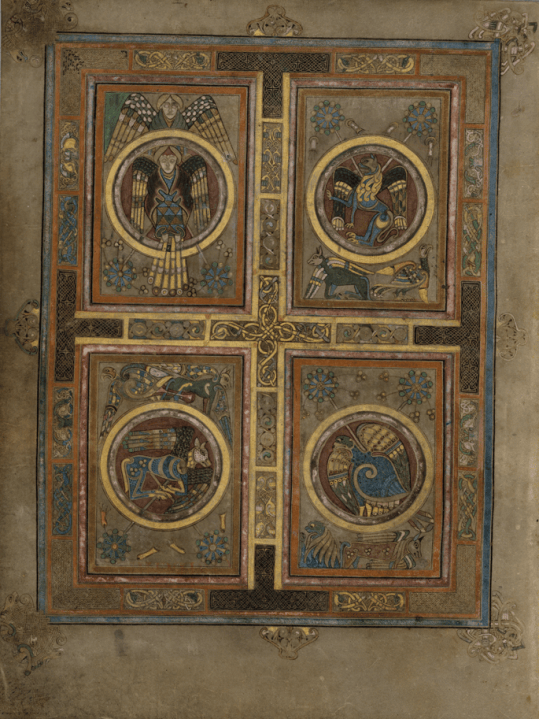
Folios 129v – 130r, Gospel of Mark
Caoimhe Ní Ghormáin
1 min read • 8 October 2026
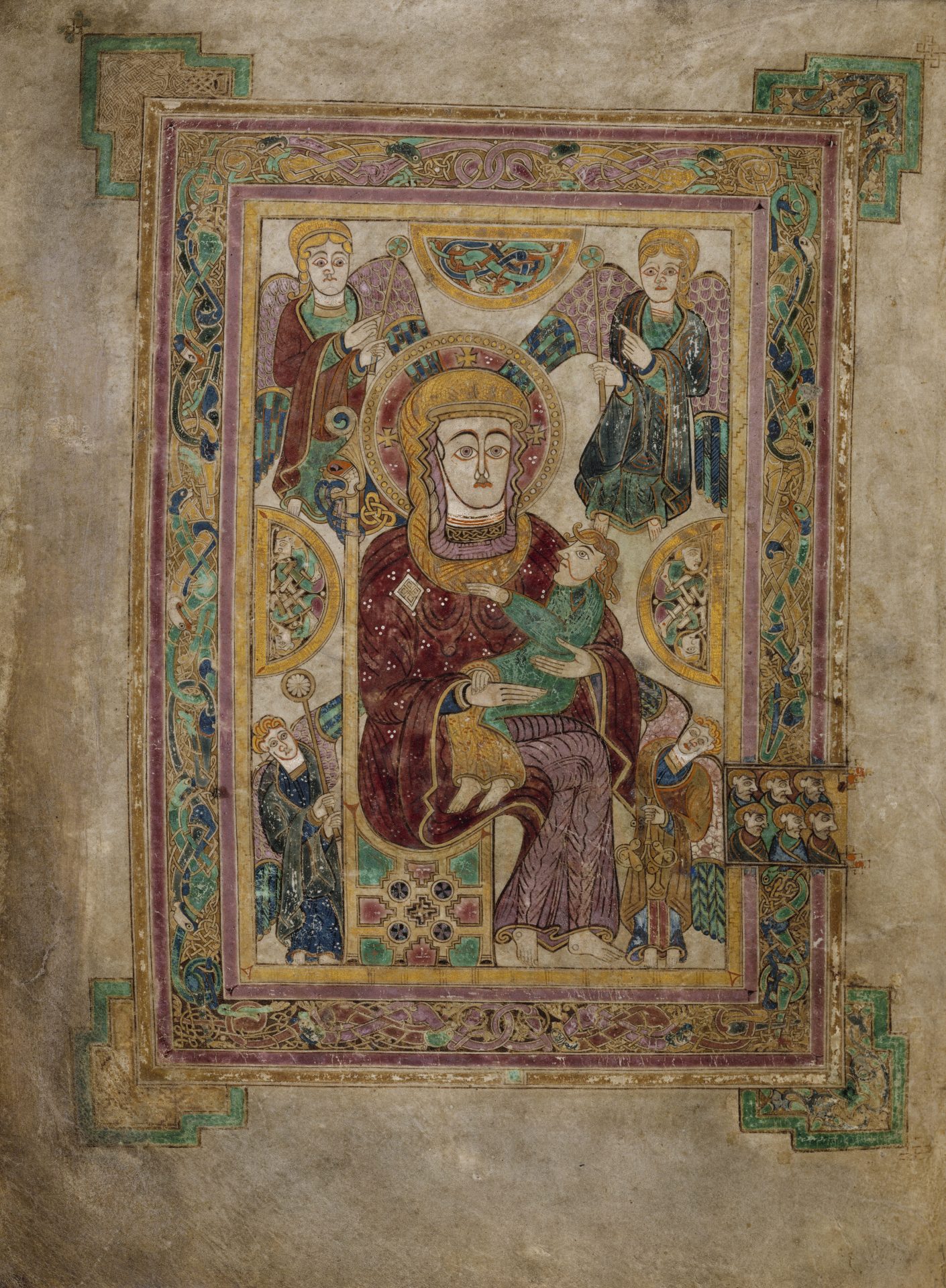
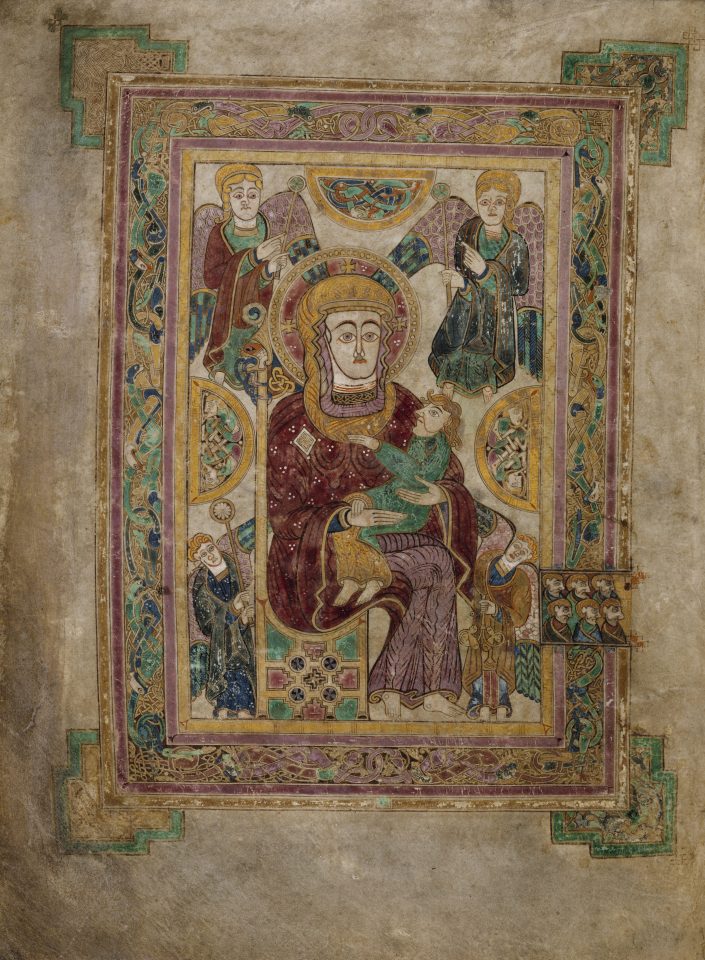
Folio 7v, Book of Kells
THE VIRGIN AND CHILD
The Virgin and Child illustration in the Book of Kells (c.800) is the earliest known extant depiction of the Virgin Mary and infant Jesus in Western manuscript art. Located on folio 7v, facing the Breves Causae of Matthew on folio 8r, it is the sole major representation of a woman in the entire manuscript.
The Virgin Mary is depicted seated on a throne with the Christ Child on her knee, surrounded by the archangels Michael, Gabriel, Raphael and Uriel. Three of the angels hold a flabellum (liturgical fan), while the fourth holds a flowering rod. The base of her throne is decorated with crosses and a lion’s head on the back of her throne represents Christ. Her brooch is in the shape of a lozenge, also representing Christ, with a further four lozenges within it. Mary wears royal purple robes and sits on a jewelled throne, styled similarly to Eastern panel icons of the period. Her robe is decorated with triple white dots, following a tradition from the East in which the motif was used for the finest garments, but here they may allude to the Trinity (the Father, the Son and the Holy Ghost). The Child touches Mary’s breast, symbolising her fundamental role as the Mother of God, and his right hand is on her right hand. The Columban community have long practiced a deep devotion to Mary: ‘She is the most high, she the holy venerable Virgin’, in the words of a hymn composed c.700.
The panel of bearded heads positioned in the frame to the right of the Virgin gaze over to the announcement of the birth of Jesus on the facing folio.
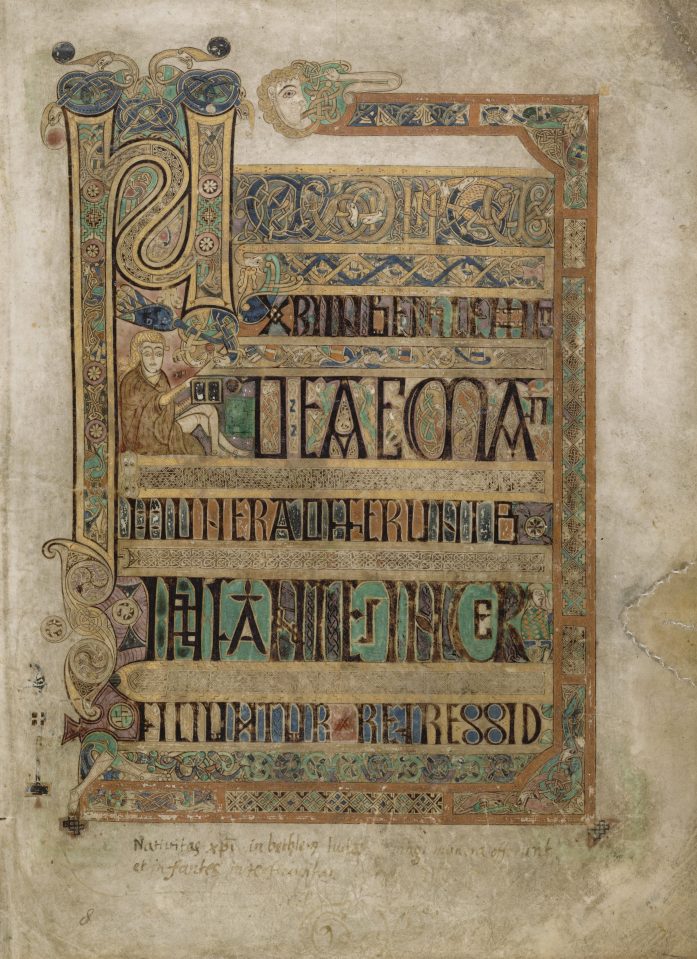
Folio 8r, Book of Kells
BREVES CAUSAE OF MATTHEW
The Breves Causae, customary in early medieval Gospel books, are lists of chapter contents. The Breves Causae of Matthew I-III open opposite the Virgin and Child page with a full-page announcement of Christ’s birth: NATIUITAS/CHRISTI IN BETHLEM IU/DEAE MAGI /MUNERA OFFERUNT ET /INFANTES INTER/FICIUNTUR REGRESSIO which translates to, ‘The birth of Christ in Bethlehem of Judea. The wise men offer gifts and the children are killed. Return of Jesus from Egypt to Nazareth’.
The page forms a complex array of both script and decoration glorifying the birth of Christ. A profile head and arm at the top draws our gaze around the border to the feet and legs. Two seated figures catch our attention: the smaller seated figure (lower right) wears a garment decorated in red and green lozenges and seems to be praying; the larger figure (centre left) holds out a book or writing tablet. Above him are two peacocks, upside down. Representations of the star of Bethlehem are placed within the initial letter of Natiuitas (‘birth’), matching the star on the flabellum of an angel on the facing page (folio 7v). At the foot of the page, chalices with sprouting vines can be seen in the second band of decoration.
1 min read • 8 October 2026
1 min read • 7 July 2026
1 min read • 12 May 2026