
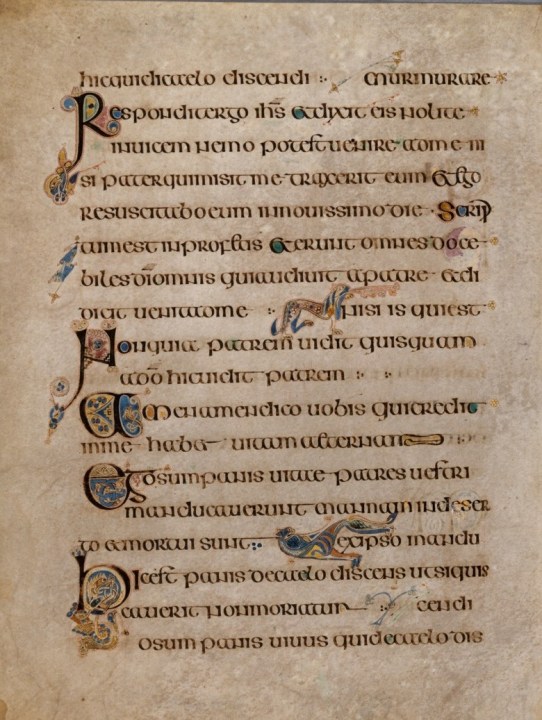
Folios 309v – 310r, Gospel of John
Caoimhe Ní Ghormáin
1 min read • 6 November 2025
Folio 113v, Book of Kells
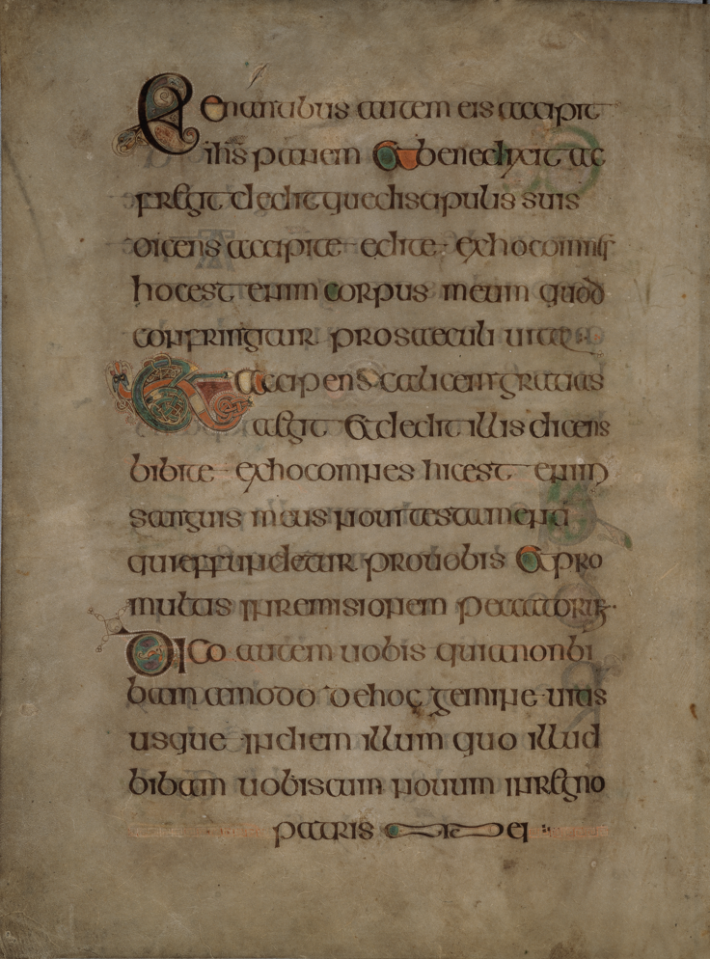
The text on Folio 113v recounts the scene of the Last Supper, opening with the well-known words:
Caenantibus autem eis accipit iesus panem et benedixit ac fregit deditque discipulis suis et ait accipite et comedite hoc est corpus meum.
‘And while they were at supper, Jesus took the bread and blessed and broke it and gave it to his disciples and said: Take ye and eat. This is my body’.
Peacocks form the initials letters of caenantibus ‘while they were dining’ on line 1 and accipiens ‘accepting’ on line 7. In the Book of Kells, peacocks symbolize Christ’s immortality and resurrection, based on the ancient belief that their flesh does not decay. They feature prominently on major pages, sometimes integrated into letters to emphasize important passages, and often appear next to images of Christ.
On line 13, the word Dico ‘I say’ is outlined with white dots, emphasising the words of Christ. Bunches of grapes also decorate the letter D, to represent the wine used in the Eucharist.
Folio 114r, Book of Kells
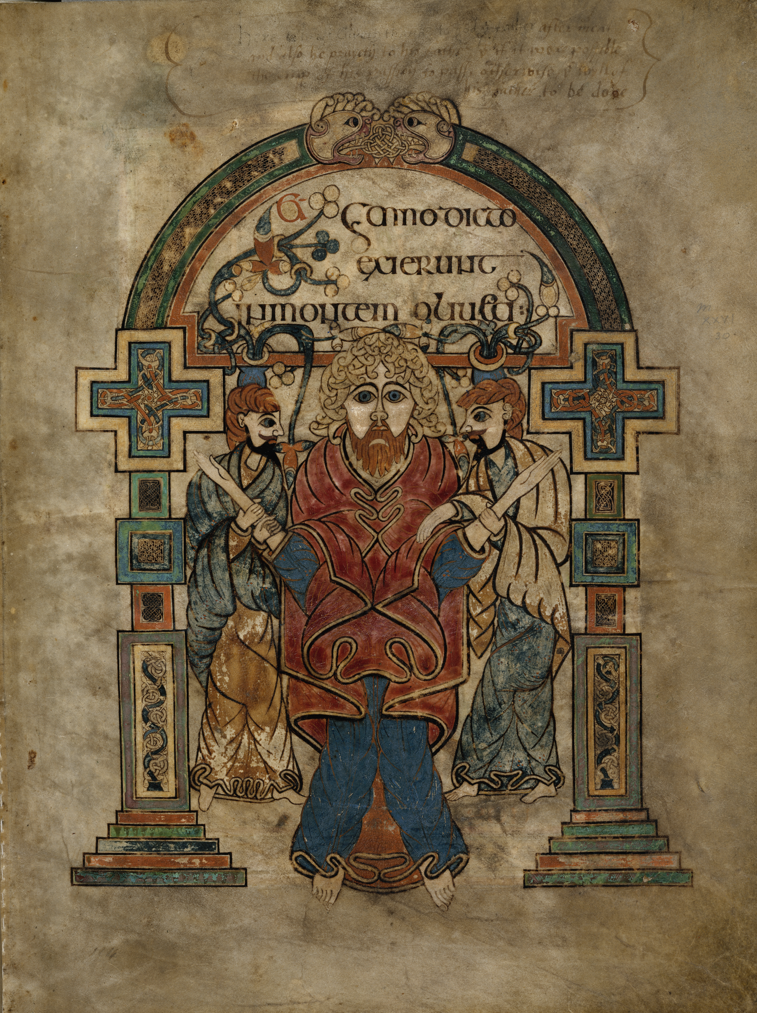
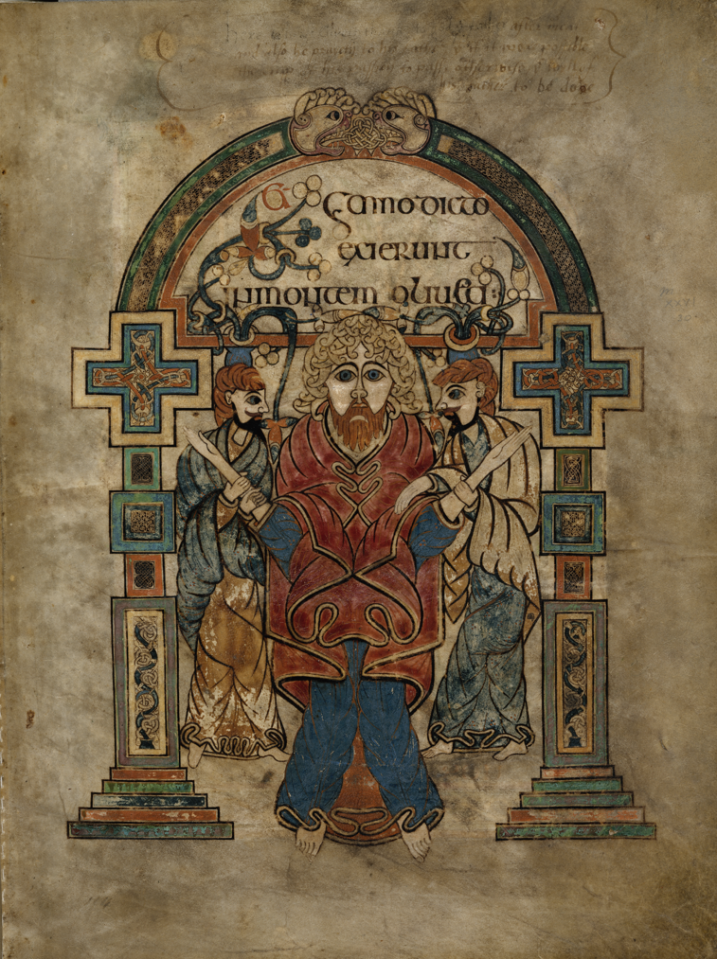
The episode where Jesus prays on the Mount of Olives is illustrated on Folio 114r. Christ gazes directly at the viewer, flanked by two smaller figures holding his arms, which are outstretched as though in prayer. His arms and legs form a saltire cross, which, together with the crosses on either side of his head, seem to anticipate the Crucifixion. The figures are placed within an arch, at the apex of which two lions, symbols of Christ, face each other, their tongues intertwining. The words Et ymno dicto exierunt in montem oliueti (‘And a hymn being said, they went out unto mount Olivet’; Matthew 26:30) are contained within the arch. Olive branches and their fruit sprout from urns beneath these words, growing upwards (to reflect the text) and down (to connect the text with the three figures).
In 1868, the English archaeologist and entomologist John Obadiah Westwood (1805-1893) identified the scene as the Arrest of Christ, a view which was widely accepted for many years. The image is not that straightforward, however, as it appears five pages before the Arrest episode is described in the text. On Folios 116v-117r in the Book of Kells, reference is made to Judas approaching Jesus with a great crowd, who are armed with swords and clubs (Matthew 26.47-50). The figures flanking Jesus on Folio 114r do not carry weapons and appear to have plants sprouting from their heads. In addition, there is no sign of Judas, one of the key figures in the story. Recent studies have proposed that the image should be correctly interpreted as Christ praying on the Mount of Olives.
On Folio 114r, four snakes come together in the crosses at either side of Jesus’ head, their heads meeting in discs, one red, the other marked with four dots, presumably denoting eucharistic hosts. Dual symbolism was attached to the snake or serpent in the Book of Kells. Responsible for the fall of Man due to its role in Man’s loss of innocence in the Garden of Eden (Genesis 3:1-5) – and so synonymous with the Devil – the snake was also a common symbol of Christ’s Resurrection from the dead. The decoration of the base of the pillars which support the frame incorporates chalices with sprouting vines – a visual reference to the Eucharist.
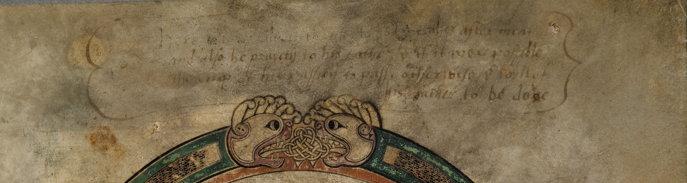
Annotation, Folio 114r, Book of Kells
The faded annotation at the top of Folio 114r is by Gerald Plunket of Dublin, who was in possession of the Book of Kells in the 16th century and annotated frequently throughout the manuscript, mostly commenting on the gospel chapters and the folio count. Here, he appears to paraphrase the text of Matthew 26.39.
1 min read • 6 November 2025

1 min read • 11 September 2025

1 min read • 19 August 2025