
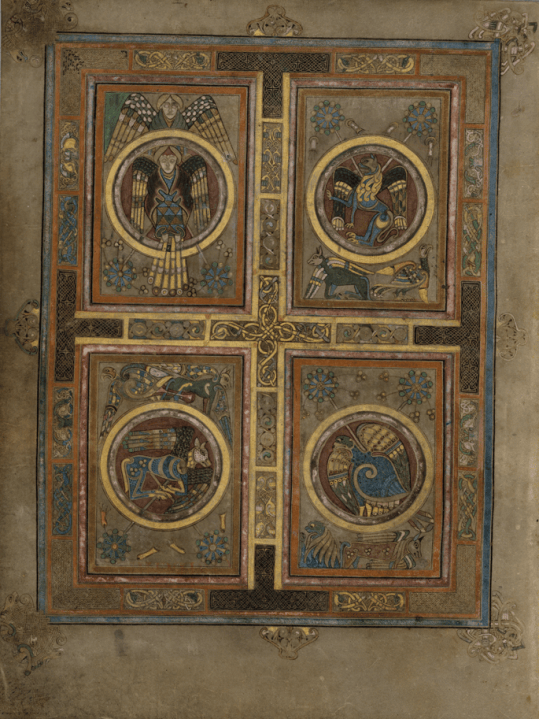
Folios 129v – 130r, Gospel of Mark
Caoimhe Ní Ghormáin
1 min read • 8 October 2026
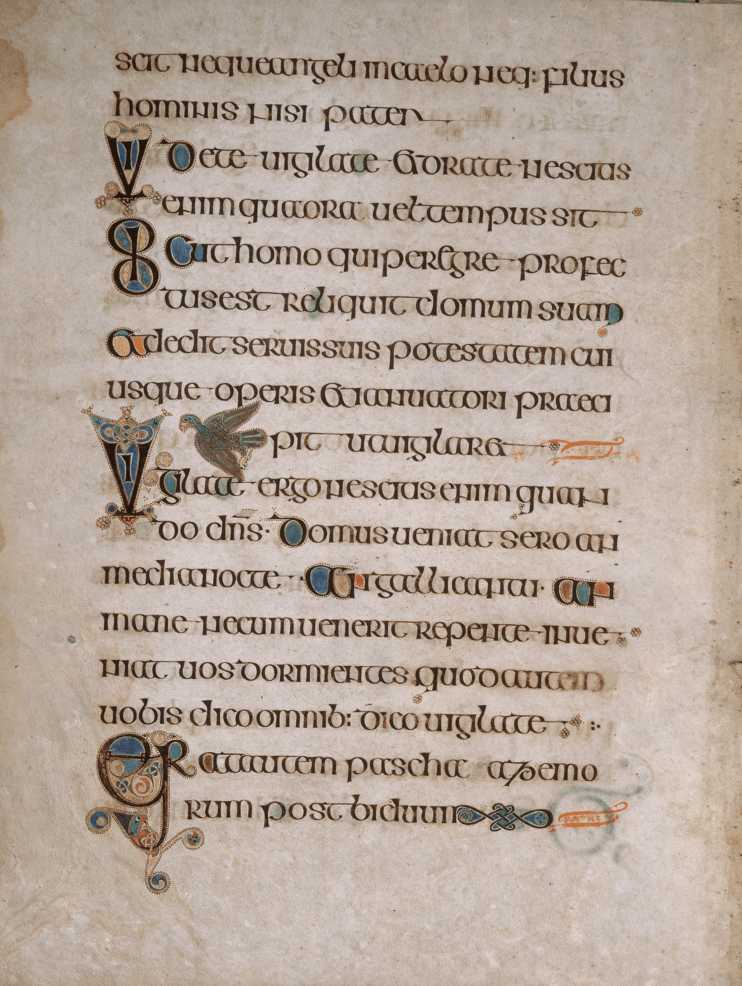
Folio 174v, Book of Kells
In the gospel of Mark 13:32-37 Jesus concludes the Olivet Discourse, which is the account of Jesus’ teachings to his disciples on the Mount of Olives, overlooking the Temple in Jerusalem. The Olivet Discourse is also known as the Little Apocalypse. The principal message to the followers of Jesus is to remain watchful and be prepared for his return because the timing is unknown.
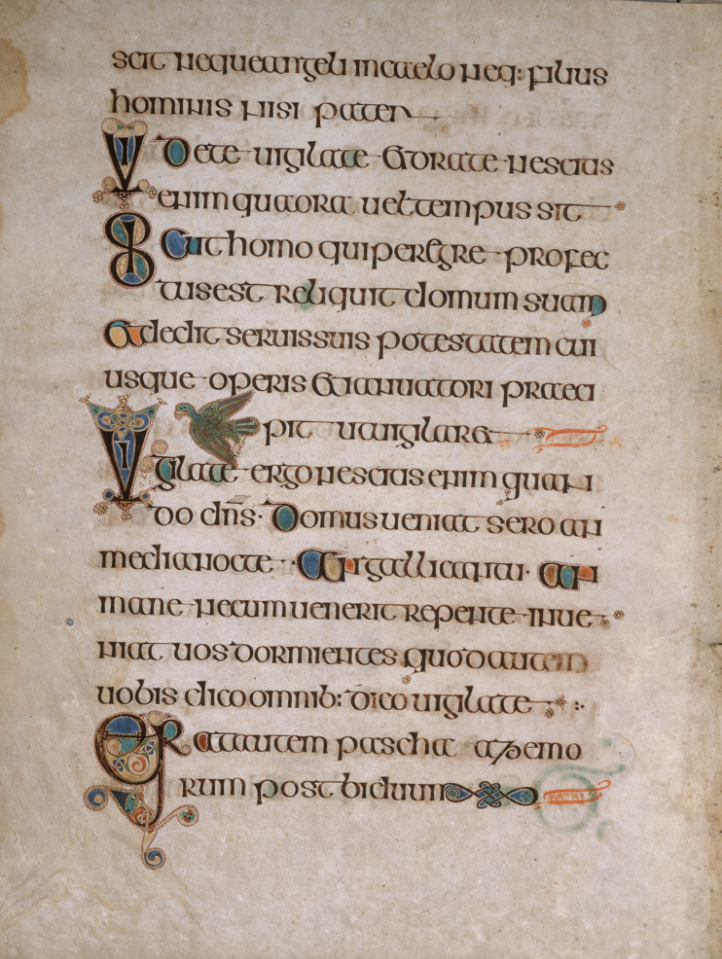
The decoration across the opening intensifies at the most important section of the text. The first decorated initial letter is V (line 3, folio 174v) of videte vigilate et orate nescitis enim qua ora vel tempus sit warns the followers of Jesus ‘take ye heed, watch and pray. For ye not know when the time is’. The scribe has inserted the letter i within the initial letters of Videte (line 3), Sicut (line 5) and Vigilate (line 10). This harmonious repetition draws the reader’s eye to this critical passage in the text.
A splendid eagle flies across the middle of the page acting as a hyphen, connecting the two parts of the word praeci-pit (‘commanded’) split between lines 8 and 9. The eagle’s eye is focussed on the word Vigilate, again drawing attention to a key word.
The elaborately decorated Er of Erat (‘to be’) at the beginning of line 16 on folio 174v marks the beginning of chapter 14 of the gospel of Mark. A peacock dangles from the descender of the R. Peacocks in the Book of Kells are prominent, symbolic creatures representing Christ’s immortality, resurrection, and incorruptibility, based on ancient beliefs that their flesh did not decay. They appear frequently on major pages, often flanking images of Christ or at the end of text lines. The outline of red dots around the initial R is a further scribal technique to highlight the beginning of this new important chapter.
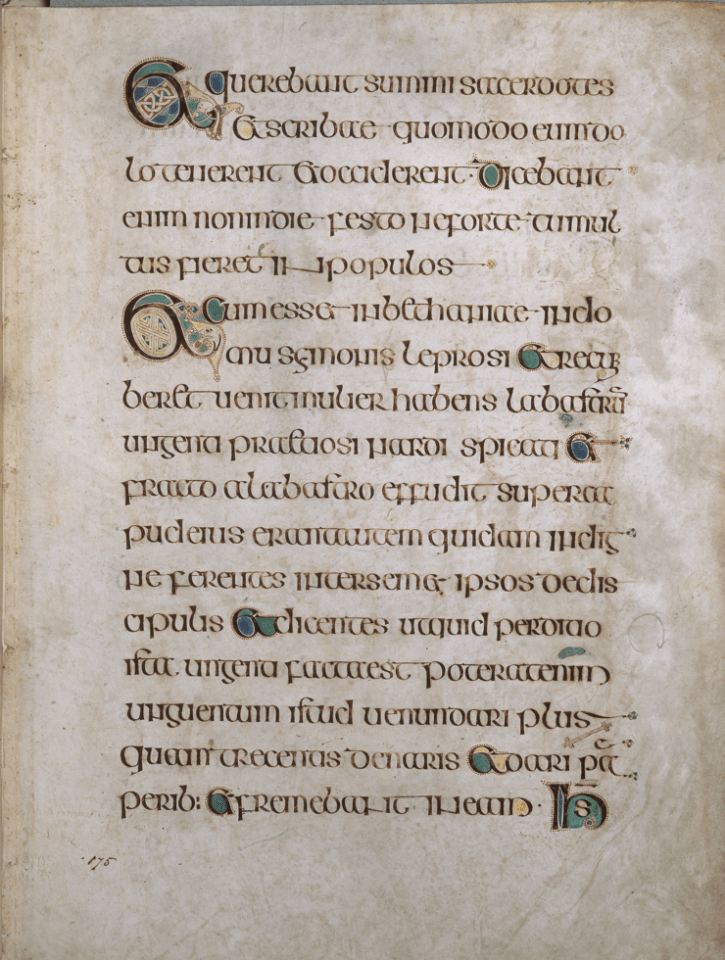
Folio 175r, Book of Kells
The chief priests’ plot to kill Jesus in Mark 14:1-6 highlights the imminence of Jesus’ death, and the Anointing in Bethany foreshadows his burial.
The first decorated initials of line 1 et quaerebant (‘and they sought’) introduces the chief priests plot to kill Jesus. A lion’s head with a protruding and curling tongue dangles from the letters Et (‘and’), outlined in red dots for emphasis. In general, the lion’s head with a protruding tongue in the Book of Kells is a motif stressing the word of God or Christ.
On line 6, a second lion with a protruding tongue forms the Et of et cum esset Bethaniae (‘and when he was in Bethania’), highlighting the importance of this significant gospel event occurring shortly before Jesus’ crucifixion, where a woman (identified as Mary, sister of Lazarus) anoints Jesus with oil in preparation for his burial.
The word recumberet (‘he lay down’) is split between line 7 (recum) and line 8 (beret) with the letter m flipped on its side. This is a recurring space-saving device used by scribes in the Book of Kells even when space is not an issue. A double-barred cross device above line 16, marks the abbreviated pa(up)erib(us) (‘to the poor’), split between two lines.
At the end of line 17 on folio 175r the abbreviated word form for Jesus Ihs appears surrounded in red dots. The Book of Kells scribes used instantly recognisable abbreviations for frequently used words such as Ihs (Iesus), XPS (Christus) and DNS (Dominus). They saw Latin in visual terms with its own set of graphic symbols.
Bunches of grapes appear dotted at the ends of lines on this folio and are recurring symbols of the Eucharist in the Book of Kells, representing the blood of Christ and the sacrifice of his body. A faint annotation appears on the outer margin of line 13, probably in the hand of serial 16th-century annotator Gerald Plunket of Dublin.
1 min read • 8 October 2026

1 min read • 26 August 2026
1 min read • 7 July 2026